Wimple Wp Form Plugin

Build Powerful Web Froms for WordPress

Easy create and manage contact froms, feedback forms, customer inquiries, complaints, job applications, and more with flexible fields, validation, and reliable email delivery.

Overview

SARANGSoft WIMPLE Web Form plugin fulfills these requirements for WordPress-based websites and apps. WordPress developers can create any type of form for WordPress-based websites. The plugin offers controls like Text Area, Check-Box, Drop-down List, Multi-select Drop-down with Check-Box, Radio Button, Date field, Note section etc.

Key Features

Form Builder & Management

Create and manage unlimited forms for different pages and use cases.

Build forms visually from the WordPress admin panel without any coding.

Add, edit, delete, resize, and rearrange fields at any time.

Flexible Field Configuration

Choose from multiple field types including text, dropdowns, radio buttons, checkboxes, dates, CAPTCHA, and reCAPTCHA.

Configure custom labels, prompts, help text, and validation messages for every field.

Place single or multiple fields in a row and fully control layout and positioning.

Design & Live Preview

Preview forms in real time while creating or modifying them.

Select from five ready-made themes or use the site's default theme.

Customise generated HTML and CSS to match your website branding.

Access Documents

Configure custom sender and recipient email addresses.

Receive automated form submissions via SMTP, AWS SES, or Twilio SendGrid.

Protect forms against spam using Google reCAPTCHA or standard CAPTCHA.

Benefits

Faster Form Creation

Launch professional forms quickly without development effort.

Easily manage and update forms from a single dashboard.

Reuse existing forms across multiple pages to save time.

Improved User Experience

Create intuitive forms with the right field types for every requirement.

Provide clear guidance through custom prompts and validation messages.

Build responsive, well-structured layouts that improve completion rates.

Consistent Website Branding

Ensure forms blend seamlessly with your site's design.

Apply themes and styling without modifying code.

Instantly preview changes before publishing to maintain quality.

Reliable & Secure Data Collection

Reduce spam and bot submissions with built-in CAPTCHA protection.

Improve email deliverability using trusted email services.

Route submissions directly to the right people with flexible email configuration.

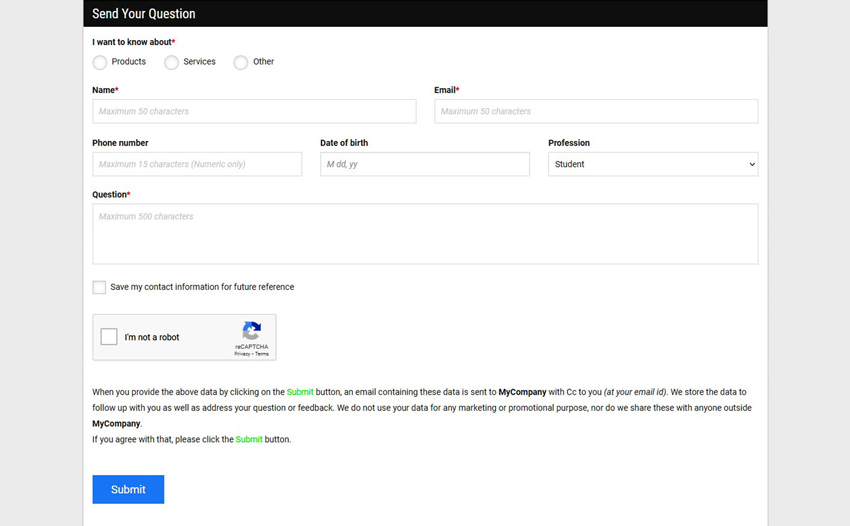
Look & Feel

Technical Details

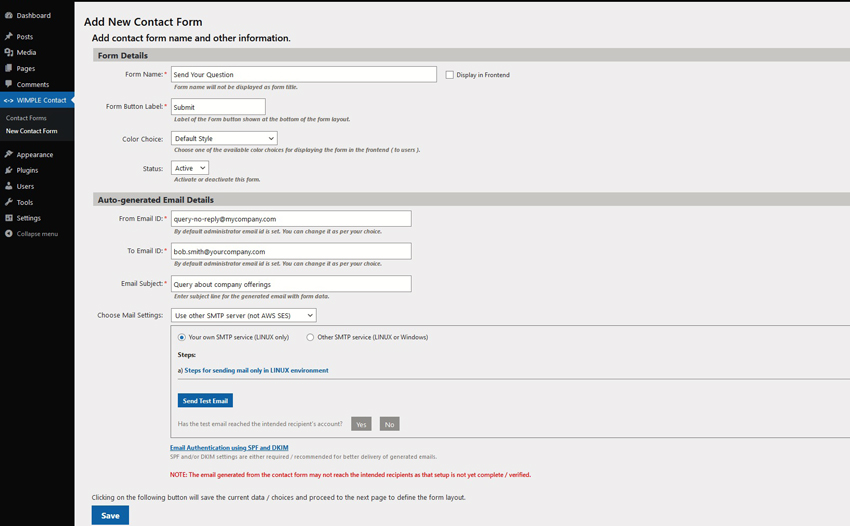
  • Go to WordPress Site Admin.
  • Click on 'WIMPLE Contact' in the left pane.
  • Initially there will be no web form. Click on 'Add New' in the top-left area.
  • Start by providing the 'Form Details', which includes 'Form Name', CAPTCHA details, form color etc.
  • In the 'Mail Settings' section, specify the email settings -- including the 'sender' (from) and 'recipient' (to) email ids -- for sending the auto-generated email with the form data.
  • Once the settings are done, please click on the 'Save' button to go to the next page.
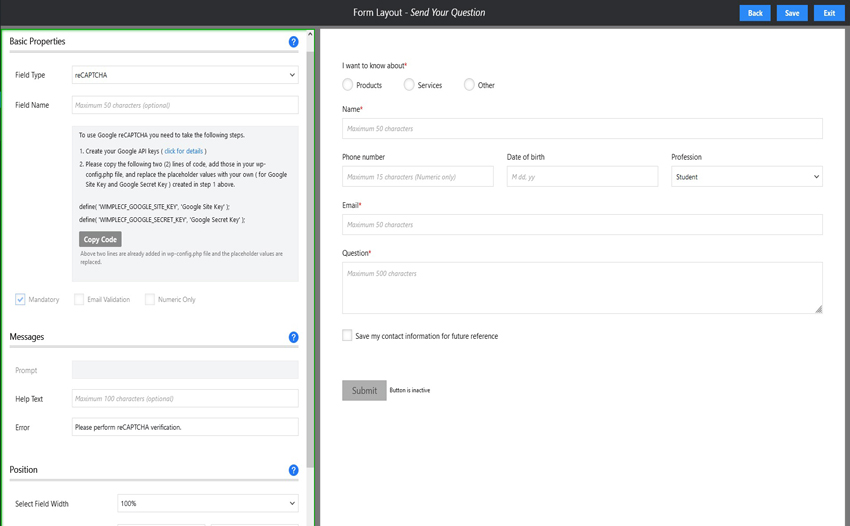
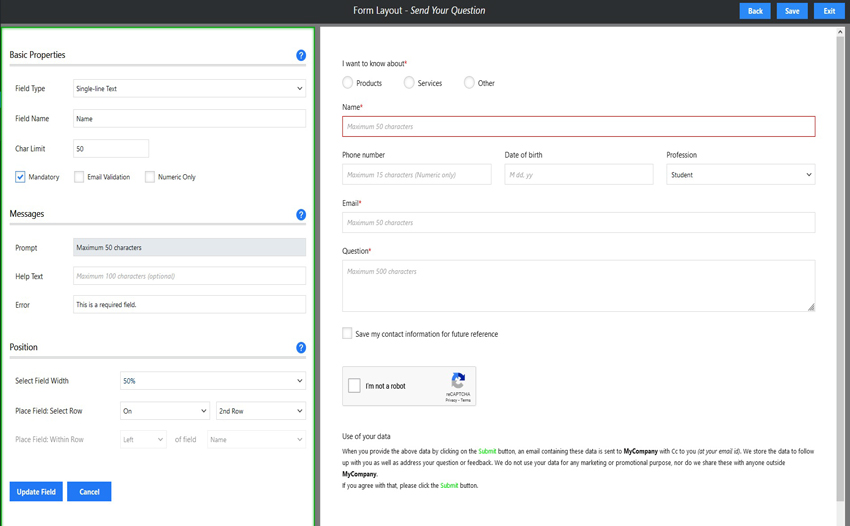
  • In the next page you need to define the fields for the form in frontend.
    For each field, please specify -
    • Field Name, which will be shown as the label for the field in frontend.
    • Field Type will specify which control you want to use, e.g., single-line text or multi-line text or check-box or radio button or drop-down list etc.
    • Whether it is a mandatory field, or a field that will take only a valid email id or only a numeric digit.
    • Its 'help' text, which will be be shown below the field (to assist the user about the field and its acceptable value / format), and the error message in case field data validation fails (because invalid data is entered by the user in the frontend.
    • Position of the field within the form. In which row it will be placed and before / after which field it will be placed if that row already contains at least one field.
  • After you add each field, you can view the form layout.
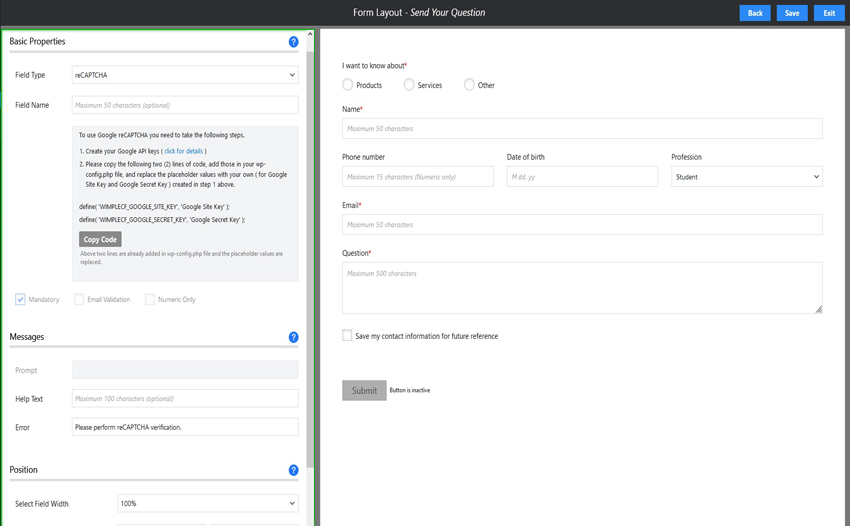
  • You can select each field from the form layout and edit its properties and its position within the form.
  • Once you click on 'Save', you will return to the list of forms where you will see your newly created form.
  • You will need to copy the ‘Shortcode’ for the form and use WordPress function ‘do_shortcode()’ with the Shortcode in the PHP file for the required web page to show it in the frontend.